
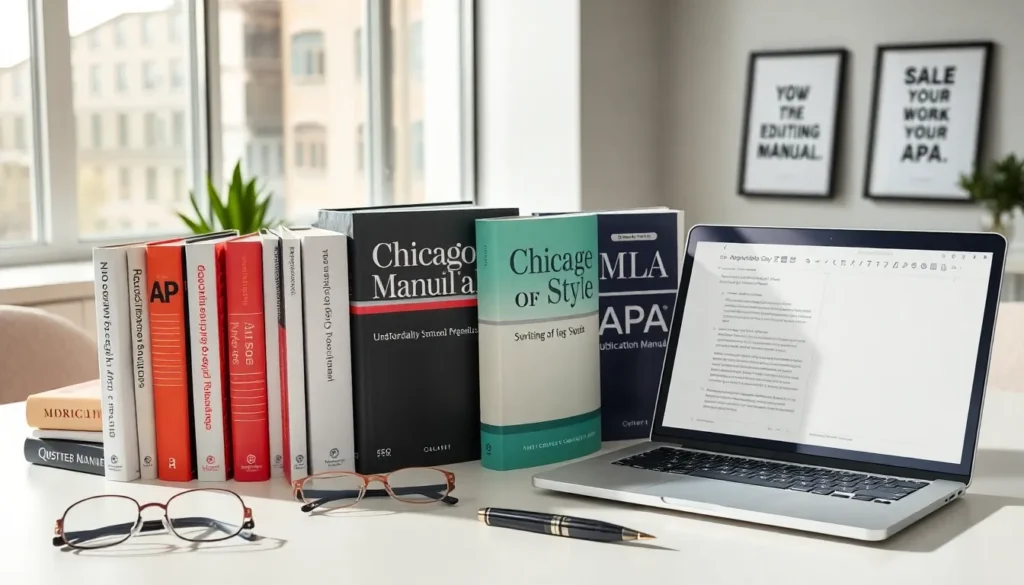
Top style guides shape how writers communicate across industries. Whether someone writes news articles, academic papers, or marketing copy, style guides provide the rules that keep content consistent and credible.
These reference manuals cover everything from comma placement to citation formats. They eliminate guesswork and help teams produce polished work. For writers serious about their craft, knowing the major style guides isn’t optional, it’s essential.
This article breaks down the most influential style guides in use today. It explains what each one does, who uses it, and how writers can pick the right guide for their projects.
Table of Contents
ToggleKey Takeaways
- Top style guides like AP, Chicago, MLA, and APA provide essential rules for consistent, credible writing across industries.
- AP Style dominates journalism and media with its focus on brevity, while Chicago Manual of Style serves book publishing and humanities with detailed formatting options.
- MLA Handbook is ideal for literature and language studies, emphasizing authorship and accessible citations for academic papers.
- APA Publication Manual is the standard for social sciences, psychology, and education, prioritizing recent research and bias-free language.
- Choose the right style guide based on your industry standards, target audience, and document purpose to ensure professional, polished content.
- Learning at least two top style guides expands your versatility and opens more writing opportunities across different fields.
What Is a Style Guide and Why Does It Matter?
A style guide is a set of standards for writing and formatting documents. It tells writers how to handle grammar, punctuation, capitalization, and citations. Think of it as a rulebook that keeps everyone on the same page.
Style guides matter because consistency builds trust. When readers see the same formatting throughout a document, they focus on the message instead of the mistakes. Inconsistent writing, switching between “email” and “e-mail” or using different date formats, distracts readers and undermines credibility.
Organizations use style guides to maintain brand voice across teams. A company with fifty writers needs shared standards. Without them, content feels disjointed. One writer might spell out numbers while another uses digits. Style guides solve this problem.
The top style guides also save time. Instead of debating whether to use the Oxford comma, writers check the guide and move on. This speeds up editing and reduces revision cycles.
Different fields have developed their own style guides over decades. Journalism follows different rules than academic writing. Scientific papers have different citation needs than humanities research. Understanding these distinctions helps writers choose the right tool for each project.
AP Style Guide
The Associated Press Stylebook, commonly called AP Style, dominates journalism and media writing. First published in 1953, it has become the standard for newspapers, magazines, websites, and broadcast news.
AP Style prioritizes brevity and clarity. Journalists work under tight deadlines and word limits, so this style guide strips away unnecessary elements. It generally avoids the Oxford comma. It prefers shorter sentences. It uses abbreviations where readers will understand them.
Key features of the AP Style Guide include:
- Lowercase job titles when they follow a name
- Spell out numbers one through nine, use figures for 10 and above
- Use quotation marks for composition titles instead of italics
- Abbreviate months when used with specific dates
AP releases annual updates to address new terminology and cultural shifts. Recent editions have added guidance on covering race, gender identity, and technology topics.
Public relations professionals, corporate communicators, and content marketers frequently adopt AP Style. Its focus on accessible language makes it practical for reaching general audiences. Writers who work in news media or create press releases should master this style guide first.
Chicago Manual of Style
The Chicago Manual of Style (CMOS) has guided publishers since 1906. Now in its 17th edition, it remains the go-to reference for book publishing, academic writing in humanities, and long-form content.
This style guide runs over 1,000 pages. It covers nearly every writing question imaginable. Where AP Style offers quick answers, Chicago provides detailed explanations and multiple options.
Chicago offers two citation systems. Notes-bibliography style uses footnotes or endnotes paired with a bibliography, popular in history, literature, and arts. Author-date style places citations in parentheses within the text, similar to scientific formats.
Notable Chicago style conventions include:
- Use the serial (Oxford) comma before “and” in lists
- Italicize titles of books, journals, and albums
- Spell out numbers zero through one hundred in most contexts
- Use en dashes for number ranges
Authors writing books, dissertations, or scholarly articles in humanities often work with Chicago style. Publishers expect manuscripts to follow these standards. The comprehensive nature of this style guide makes it valuable for complex projects with many formatting decisions.
Chicago also publishes a companion called “The Chicago Guide to Grammar, Usage, and Punctuation” for writers who want deeper instruction on language mechanics.
MLA Handbook
The Modern Language Association publishes the MLA Handbook, now in its 9th edition. This style guide serves students and scholars in literature, languages, cultural studies, and related fields.
MLA style emphasizes authorship and source accessibility. Its citation format highlights author names and page numbers, making it easy for readers to locate original sources. The parenthetical citation system places author and page information directly in the text.
A typical MLA citation looks like this: (Smith 42). The Works Cited page at the end provides full source details.
Core MLA style rules include:
- Double-space all text
- Use 12-point Times New Roman or similar font
- Create 1-inch margins on all sides
- Include a header with last name and page number
- Italicize titles of longer works, use quotation marks for shorter pieces
High school and undergraduate courses frequently require MLA format for essays and research papers. The style guide’s straightforward rules make it accessible for students learning academic writing conventions.
MLA has simplified its citation approach in recent editions. Instead of memorizing different formats for books, articles, and websites, writers now apply a universal template to all source types. This change reflects how sources increasingly appear across multiple platforms.
APA Publication Manual
The American Psychological Association publishes the APA Publication Manual, currently in its 7th edition. Social sciences, psychology, education, nursing, and business programs rely on this style guide.
APA style prioritizes recent research and clear attribution. Its author-date citation system, (Johnson, 2023), lets readers quickly identify when a source was published. In fields where knowledge evolves rapidly, publication dates matter.
The Reference list at the end of APA papers provides complete source information. Each entry follows a specific order: author, date, title, source.
Key APA style requirements include:
- Use title case for headings
- Include a running head on each page
- Use past tense when describing research procedures
- Create an abstract of 150-250 words for research papers
- Use et al. after the first citation for works with three or more authors
APA also provides extensive guidance on reducing bias in language. The manual addresses how to write about age, disability, gender, race, and socioeconomic status respectfully.
Graduate students in psychology, education, and social sciences will use APA style throughout their academic careers. Many professional journals in these fields require APA format for submissions. Learning this style guide opens doors for publication.
How to Choose the Right Style Guide
Choosing among top style guides depends on three factors: industry, audience, and purpose.
Start with industry standards. Journalists use AP. Book authors use Chicago. Psychology researchers use APA. English literature students use MLA. Following the expected style guide shows professionalism and makes editors’ jobs easier.
Consider the audience next. General readers prefer the clean, direct approach of AP style. Academic readers expect the detailed citations of Chicago, MLA, or APA. Technical audiences may need specialized guides like the IEEE style for engineering.
Purpose also guides the choice. A press release calls for AP style. A history dissertation needs Chicago. A psychology research paper requires APA. Match the style guide to the document type.
Some situations offer flexibility. Blog posts and marketing content can adapt rules from multiple style guides. Many companies create internal style guides that borrow elements from several sources.
Writers benefit from learning at least two style guides well. Someone who knows both AP and Chicago can handle journalism assignments and book projects. A student who masters MLA and APA can write papers across humanities and social sciences.
Keep style guides accessible during writing. Digital subscriptions to AP Stylebook and Chicago Manual of Style allow quick searches. Physical copies of MLA and APA handbooks work well as desk references.

